IFNC 2011: The International Food & Nutrition Conference
This website was create for the purpose of providing information for the conference. Details and materials related to past and future conferences was promised to be added to this site over time. For those of us who attended the 2011 International Food & Nutrition Conference, it was an instructional three day conference. I was am looking forward to the next one which is scheduled for 2016. However, the website's domain expired and the site disappeared from the web.

The International Food & Nutrition Conference (IFNC) 2011, organized by Tuskegee University's Food and Nutritional Sciences department, was a significant event focusing on sustainable approaches to food and nutrition. It addressed pressing issues such as childhood obesity, chronic diseases, and food security, with a multi-sectoral approach involving various experts and stakeholders. The conference was a vital platform for discussing and strategizing solutions to these global challenges.
As an attendee, I was deeply impressed by the conference's comprehensive approach to addressing key issues in food and nutrition. The event stood out as a pivotal platform for discussing sustainable solutions to global challenges like childhood obesity, chronic diseases, and food security. One of the most memorable moments was Dr. Alan Watlin's presentation on food insecurity. His choice to wear a Superman hoodie while delivering such a critical talk was both striking and thought-provoking. It sparked considerable curiosity among the audience, many of whom were intrigued about the source of the hoodie. The revelation on the last day that it was from MoonAtMidnight.com added an interesting twist, reflecting the unique and innovative spirit of the conference.
Since the 2011 conference was chaired and co chaired by Adelia C. Bovell-Benjamin, PhD. and Ralphenia D. Pace, PhD, RD, LD, respectively from the Tuskegee University, I would suggest going to the Tuskegee University website to see if there are any notifications about upcoming Food & Nutrition conferences: www.tuskegee.edu/academics/colleges/caens/food_nutritional_sci.aspx
Recently I discovered that the domain was available, so I bought it with the goal of recreating as much of its original content as possible from archived pages. I did not want someone else to purchase the domain and re-purpose the site for something that had nothing in common with the original ifnc2011.info website.
PLEASE NOTE THAT THIS PAGE CONTAINS SELECTED ARCHIVED CONTENT FROM THE ORIGINAL SITE.
Consider the information on this site for its historical value.
+++
The IFNC | The International Food & Nutrition Conference exists to promote sustainable approaches in food and nutrition. With the further goal being to combat the disparities in childhood obesity, chronic diseases and food security. We’ve recently revamped our website, created a facebook page and a twitter profile, Google+, and LinkedIn. Please Like and Follow our pages and help us build our community. We hope in the coming months to continue to grow our membership and the channel the voices and knowledge of our active members into a lively community and content rich environment for all things food and nutrition. We’ve also created an email distribution that you can sign up for and get the latest updates on the IFNC and relevant food and nutrition topics.
The IFNC is comprised of volunteers, scientist, researches and policy experts. This body is headed by Adelia C. Bovell-Benjamin, PhD, and Ralphenia D. Pace, PhD, RD, LD of Tuskegee University. Governance of the IFNC is maintained by the department of Food and Nutritional Sciences (FNS) at Tuskegee University. The department has hosted a conference for IFNC members and sponsors every 5 years. The most recent conference was the Third International Food and Nutrition Conference that was held on October 9-11th, 2011. IFNC 2011 was held at the Kellogg Hotel and Conference Center, Tuskegee, Alabama, USA. The next live event conference is slated for 2016. Details and materials related to past and future conferences will be added to this site over time.
+++
About the IFNC
Sustainable Approaches in Food and Nutrition to Combat Disparities in Childhood Obesity, Chronic Diseases and Food Security
Governing Body Objectives:
- To forge links and stimulate new areas of multidisciplinary research among countries where disparities are increasing childhood obesity, food/nutrition insecurity, health and chronic diseases;
- To generate knowledge, which will impact future policy, community, research and education decisions relating to increasing disparities in childhood obesity, food/nutrition insecurity, health and chronic diseases;
- To engage and interact with a range of relevant scientific disciplines to promote mechanisms, guidelines and processes for ensuring the relevance and effectiveness of an integrated food and nutrition policy in the face of global disparities in childhood obesity, food insecurity, chronic diseases and environmental crisis;
- To create new consensus, publicize opportunities for new research, and provide sustainable approaches for combating disparities in childhood obesity, chronic diseases and food and nutrition insecurity in a changing environment; and
- To build capacity among scientists focusing on food, nutrition and related sciences, disparities in childhood obesity, chronic diseases, and food and nutrition insecurity.
+++
​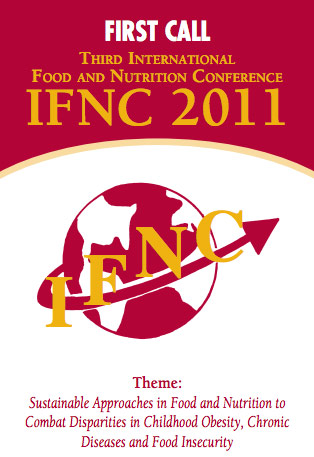
Theme:
Sustainable Approaches in Food and Nutrition to Combat Disparities in Childhood Obesity, Chronic Diseases and Food Insecurity
OCTOBER 9-11, 2011 IFNC
TUSKEGEE U N I V E R S I T Y
Kellogg Conference Center
Tuskegee, AL 36088
IFNC 2011 is an innovative multi-sectoral, multidisciplinary approach that will effectively disseminate the messages and solutions to ameliorate disparities in: childhood obesity, chronic diseases, food/ nutrition insecurity, and global crisis (environmental, climatic, and economic). This approach will allow participants to better understand causes of disparities in childhood obesity, chronic diseases food/nutrition insecurity and global crisis; and focus on the development of sustainable approaches/solutions in a more holistic manner than in the past. Furthermore, this thematic approach to the problematic areas would ensure that each of the many facets of the problems are discussed, thus allowing each sector or discipline to assess and provide solutions for improvements.
Overall, IFNC 2011 will address food, agriculture and nutrition as an integrative science, linking with other disciplines such as biomedical and life sciences, social and behavioral sciences, law, economics and public health to engage and advance evidence-based policies and programs with comprehensive food and health delivery systems.
+++

1) DISPARITIES IN CHILDHOOD OBESITY
Roughly 22 million of the world’s children under 5 years are estimated to be overweight. For example, in Thailand the prevalence of obesity in 5 to 12 years old increased from 12.2 to 15.6% in two years, and approximately 25% of Australian children are either overweight or obese. Compelling data indicate that globally, there is a persistent and increasing disparity in the rate of childhood obesity. This session will analyze the latest research findings for policy and practice in the early stages of development of childhood obesity; infant to adolescent feeding practices; child care, home and food environment; education, economic, legal, environmental resources and interventions for promoting and supporting activities which decrease childhood obesity; and promote prevention and management. It will also highlight strategies and practices, along with the legal and bioethical challenges and constraints facing obesity prevention efforts. It will
examine disparities among diverse groups of children and showcase effective proactive programs.
2) CHRONIC DISEASE EPIDEMIC
Participants will review causes and learn sustainable strategies on preventing and treating major chronic diseases while examining the disparities in chronic diseases that exist among diverse population groups. This problematic area will also offer sustainable approaches to eliminate these disparities through the presentation of successful multidisciplinary models.
3) FOOD AND NUTRITION INSECURITY AND RELATED
BIOETHICAL IMPLICATIONS
Food security is a complex sustainable development issue, linked to health through nutrition, with economic, environmental, legal and trade implications. According to FAO world hunger reached a historic high in 2009, with more than one billion food insecure individuals. In recent years, researchers have linked food/nutrition insecurity to a wide range of negative health, legal and behavioral outcomes, such as under nutrition, chronic hunger etc. This session will discuss current knowledge about food/nutrition insecurity and its impact on populations throughout the world, including bio-ethical, legal and public health implications. It will also address what is known about the capacities and strategies of individuals, households, communities and countries to reduce food/ nutrition insecurity; and what do these strategies imply for the support needed from policymakers, government etc in the development of food policy. The session will also examine policies, programs, interventions and case studies from “Feed the Future” that have sought to promote sustainable, scalable solutions to food/nutrition insecurity. The impact of food production systems and income reduction as it relates to food/nutrition insecurity will be reviewed. The multidisciplinary research and evidence-based presentations and discussions should lead to identification of sustainable approaches to improve food /nutrition security.
4) GLOBAL CRISIS
The global crisis poses a variety of threats to childhood obesity, chronic diseases and food/nutrition insecurity now and in the future. We have the responsibility to respond and prepare for these threats. This session will discuss current knowledge about global climatic, economic and environmental changes, their impact and relation to childhood obesity, chronic diseases and food/ nutrition insecurity at different levels. Bioethical, legal and public health implications will also be considered. It will also address what is known about the capacities and strategies to respond effectively to climatic, economic and environmental changes as they impact on childhood obesity, chronic diseases and food/nutrition insecurity. The implications of these strategies and the support needed from community-based organizations, NGOs etc. will be addressed. The session will also examine policies, programs and interventions that have sought to mitigate the effects of climatic and environmental and economic changes as they relate to problematic areas. The impact of climate-related animal and plant production and diseases on the stability of food production systems; and income reduction as they relate to the problematic areas.
+++
WHO SHOULD ATTEND
Academia Industry/Government Public Interest Groups Medical Doctors Paraprofessionals Bioethicists International Agencies National Agencies Climatologists Meteorologists Nutritionists & Dietitians Demographers Environmentalists Biotechnologists Public Health Lawyers Food Law Regulators Social Scientists Cooperate Extension Rural, Urban and Transportation Planners Food Processors/Engineers/Distributors Non-Governmental Organizations (NGOs) Community-Based Organizations (CBOs Food & Agricultural Scientists Public Health Professionals, ETC.
+++
TENTATIVE PROGRAM
SUNDAY, OCTOBER, 9 2011
11:00- 2:00.p.m
Pre-Conference Workshop
Bioethical Implications and
Resolutions for Disparities in
the Prevention, Management and
Treatment of Childhood Obesity
2:00 - 6:00 p.m. On-Site Registration
2:00 - 8:30 p.m Exhibitors/Poster Set-ups
2:30 - 4:30 p.m. Tuskegee University Campus Tour
5:45- 7:30 p.m. General Session
7:30 - 8:30 p.m. Networking Reception
MONDAY, OCTOBER, 10, 2011
8:00 - 5:00p.m. On-Site Registration
8:00 - 12 Noon Plenary Session
12:20 - 1:30 p.m. Luncheon/Speaker
1:35 - 5:15 p.m. Oral Sessions (Concurrent)
Disparities in childhood obesity
Chronic Disease Epidemic
Food and nutrition insecurity and related bioethical implications
Global crisis
Global Fellows Forum
6:30- 8:30 p.m. Poster Reception
TUESDAY, OCTOBER 11, 2011
8:00 - 12Noon On-Site Registration
8:00 - 12 Noon Plenary Session
12:20 - 1:30 p.m. Luncheon/Speaker
1:35 - 5:15 p.m. Oral Sessions (Concurrent)
Disparities in childhood obesity
Chronic Disease Epidemic
Food and nutrition insecurity and related bioethical implications
Global crisis
Global Fellows Forum
6:30 – 9:00 p.m Banquet & Cultural Extravaganza

More Background On IFNC2011.info
IFNC2011.info was associated with the Third International Food and Nutrition Conference (IFNC 2011), an academic and professional gathering held at Tuskegee University in Alabama in October 2011. Although the conference and its website belong to an earlier era of the web, surviving records show that the event brought together researchers, nutrition specialists, food scientists, public-health professionals, agricultural experts, policymakers and other participants to consider a remarkably broad question: how can societies develop sustainable approaches to food and nutrition while reducing disparities in obesity, chronic disease and food insecurity?
The conference was not simply a nutrition meeting in the narrow sense. Its organizers deliberately treated food, agriculture, nutrition, health, economics, environmental conditions, public policy and bioethics as interconnected subjects. That multidisciplinary philosophy is perhaps the most important aspect of IFNC 2011 and helps explain why references to the conference remain scattered through academic publications, university records, researchers' curricula vitae and U.S. Department of Agriculture databases many years later.
IFNC2011.info itself no longer functions as the original conference website. The domain expired after the event and was subsequently acquired by a new owner interested in preserving material from the former site. The surviving site therefore needs to be understood primarily as a historical reconstruction rather than the current official website of Tuskegee University or an active International Food and Nutrition Conference organization.
What Was IFNC 2011?
The Third International Food and Nutrition Conference was held October 9–11, 2011, at the Kellogg Hotel and Conference Center on the campus of Tuskegee University in Tuskegee, Alabama.
Federal records independently confirm the event's identity. The USDA's National Institute of Food and Agriculture project database lists a project titled "Third International Food and Nutrition Conference (IFNC 2011)," with Tuskegee University as the institution and Adelia Bovell-Benjamin as project director. The National Agricultural Library's Food Safety Research Projects Database similarly identifies Bovell-Benjamin as investigator and lists National Institute of Food and Agriculture funding, with the project running from 2011 into 2012.
The conference theme was "Sustainable Approaches in Food and Nutrition to Combat Disparities in Childhood Obesity, Chronic Diseases and Food Insecurity."
That title captures the central philosophy of the meeting. Instead of examining obesity, hunger, disease or agriculture separately, IFNC attempted to explore the connections among them.
The historical material preserved with the domain describes IFNC 2011 as a multi-sectoral and multidisciplinary effort intended to disseminate research and develop solutions involving childhood obesity, chronic diseases, food and nutrition insecurity, and global environmental, climatic and economic pressures.
Tuskegee University's Role
Tuskegee University was central to the conference rather than simply serving as its venue.
The event was associated with the university's Department of Food and Nutritional Sciences. Historical conference material identifies Adelia C. Bovell-Benjamin, PhD, as chair and Ralphenia D. Pace, PhD, RD, LD, as co-chair, while governance of the IFNC initiative was connected with the Food and Nutritional Sciences department.
Tuskegee's involvement was especially appropriate because the university has a long history connecting agriculture, nutrition, food science, education and community development. The institution's contemporary Department of Food and Nutritional Sciences continues to conduct work involving food product development, community nutrition, food safety, nutritional science and diet-related illness.
Bovell-Benjamin remains associated with Tuskegee as a professor and researcher in Food and Nutritional Sciences. Her academic background includes nutrition, international nutrition and epidemiology, and her research has included diet-related chronic diseases, health disparities, sensory evaluation, food environments and underserved populations.
Her later career also provides useful perspective on the scientific leadership behind IFNC. In 2026, the Institute of Food Technologists named Bovell-Benjamin an IFT Fellow, the organization's highest membership honor, recognizing sustained contributions to food science and the profession. That award was received long after IFNC 2011 and therefore should not be interpreted as an award for the conference, but it illustrates the standing of one of the event's principal organizers.
The IFNC Was an Established Conference Series
The "Third" in Third International Food and Nutrition Conference is significant. IFNC 2011 was part of a continuing series rather than a one-time event created around a temporary website.
Records show that an earlier International Food and Nutrition Conference took place at Tuskegee in 2000. A Food and Agriculture Organization bibliography, for example, references a paper presented at the "International Food and Nutrition Conference 2000" at Tuskegee University.
The second conference was much better documented online. IFNC 2006 took place October 8–10, 2006, at the Kellogg Conference Center. Its theme was "Emerging Nutrition and Food Safety Challenges: A Global Perspective."
A contemporary conference announcement described plans for leading scientists and professionals from around the world to exchange information about food, nutrition, health, agriculture, food safety, bioethics and emerging technologies. Its program included technical presentations, mini-symposia, networking receptions, luncheon speakers, a banquet and a cultural extravaganza.
That establishes an important pattern: approximately every five years, Tuskegee's Food and Nutritional Sciences community organized a major interdisciplinary international conference.
The surviving IFNC2011.info material likewise stated that conferences were hosted every five years and anticipated another meeting in 2016. Whether all of the originally envisioned subsequent conference activity occurred in precisely that form is less clearly documented online, but the earlier 2000 and 2006 events independently establish the historical lineage behind the 2011 gathering.
The Four Major Problem Areas
IFNC 2011 organized much of its intellectual agenda around four large areas.
The first was disparities in childhood obesity. The organizers regarded childhood obesity not simply as an individual behavioral issue but as something affected by feeding practices, family environments, child care, education, economics, law and environmental conditions. Planned discussions included prevention, management, intervention programs and disparities among different populations.
The second was the chronic disease epidemic. Participants were expected to examine causes of major chronic diseases and sustainable approaches to prevention and treatment, particularly differences in disease burden among population groups.
The third was food and nutrition insecurity and its bioethical implications. Food security was approached as simultaneously a health, economic, environmental, legal, agricultural and trade issue. Conference material emphasized policies, interventions, food-production systems, income and scalable strategies for improving nutrition security.
The fourth was the global crisis, an umbrella category encompassing climatic, environmental and economic change. The organizers wanted participants to consider how these pressures could affect food production, chronic disease, obesity and food insecurity.
Together, these subjects made the meeting unusually expansive. They anticipated what is now frequently described as a "food systems" perspective: nutrition outcomes cannot be separated cleanly from agriculture, economics, environmental change, inequality and public policy.
A Deliberately Multidisciplinary Conference
One of IFNC 2011's distinguishing characteristics was the diversity of professions it attempted to bring together.
The historical attendee list included academics, government representatives, physicians, nutritionists, dietitians, bioethicists, public-health professionals, food and agricultural scientists, environmentalists, climatologists, meteorologists, demographers, social scientists, biotechnology specialists, lawyers, food-law regulators, planners, food processors, engineers, distributors, international agencies, NGOs and community organizations.
This was more than a marketing attempt to make the conference sound inclusive. Independent academic records confirm participation from fields well outside conventional nutrition science.
For example, sociologist Diego Thompson's academic record lists a 2011 IFNC presentation on "New Immigrants in Local Food Systems: Two Iowa Cases" as well as participation in a Food Systems Workshop for Global Fellows.
Another academic CV documents an invited presentation involving event-history calendars as a research method for tracking eating and activity patterns among children and families.
Researcher Sunday Aderoju Olabi Dada presented work involving corn supplementation, Leucaena browsing, Bermuda grass and Spanish-Boer goats. That presentation illustrates the agricultural dimension of a conference whose title might otherwise suggest that it concentrated primarily on human clinical nutrition.
The range was intentional. IFNC sought to treat food and agriculture as an integrative science linked with biomedical science, behavioral and social sciences, economics, law and public health.
International Participation and the Global Fellows Concept
The "International" portion of the conference's name was substantive.
Researchers from outside the United States participated in the IFNC series, and records from the University of the West Indies document Caribbean involvement.
Professor Neela Badrie's professional record, for example, identifies a 2011 presentation at the Third International Conference on Food and Nutrition at Tuskegee concerning obesity in the Caribbean and its association with diabetes.
A University of the West Indies faculty report also records research presented at the 2011 conference concerning abdominal risk and diabetes patients in St. Vincent.
The conference additionally included a Global Fellows Forum, which appears in the program alongside the major scientific tracks. The Global Fellows concept had precedent in the 2006 conference: University of the West Indies records state that graduate student Sharon Hooper was one of 16 Global Fellows selected to participate in that year's meeting.
These activities demonstrate an educational dimension extending beyond established senior researchers. IFNC also provided opportunities for graduate students and emerging scholars to participate in international scientific exchange.
What Happened During the Three Days?
The surviving schedule gives a good picture of the experience of attending IFNC 2011.
Sunday, October 9 opened with a pre-conference workshop addressing bioethical implications and resolutions related to disparities in childhood-obesity prevention, management and treatment. Registration and exhibitor/poster setup followed, along with a Tuskegee University campus tour. The first day concluded with a general session and networking reception.
Monday moved into the full scientific program. A morning plenary session was followed by a luncheon speaker and concurrent oral sessions covering childhood obesity, chronic disease, food and nutrition insecurity, global crisis and the Global Fellows Forum. A poster reception followed in the evening.
Tuesday repeated the combination of plenary presentations, luncheon programming and concurrent scientific sessions. The conference then ended with a banquet and "Cultural Extravaganza," giving the international gathering a cultural and social component in addition to its research agenda.
There was therefore no restaurant-style "menu" associated with IFNC2011.info in the ordinary sense. The relevant equivalent was its conference menu of workshops, plenaries, luncheons, posters, concurrent sessions, networking activities and cultural events.
Examples of Research Connected With IFNC 2011
One of the best ways to understand the conference's reach is through the scholarly trail left by participants.
Tufts University documentation concerning the Nutrition Collaborative Research Support Program states that program director Jeffrey Griffiths spoke about its Africa and Asia work at the Third International Food and Nutrition Conference at Tuskegee on October 9–11, 2011.
Diego Thompson presented research concerning immigrants and local food systems in Iowa.
Neela Badrie addressed Caribbean obesity and diabetes.
Sunday Dada's agricultural research examined goat performance under different feeding and grazing conditions.
Other professional records identify work on childhood-obesity prevention and the training of youth extension paraprofessionals.
The breadth of those subjects—from Caribbean diabetes and childhood obesity to immigrant food systems, international nutrition and animal agriculture—shows that "food and nutrition" was interpreted very broadly.
Location and the Importance of Tuskegee
IFNC 2011 took place at the Kellogg Hotel and Conference Center at Tuskegee University in Tuskegee, Alabama.
The campus location mattered. Participants were not attending a generic convention-center conference detached from an academic institution. Sunday's schedule actually included a Tuskegee University campus tour, reinforcing the connection between the event and the university.
Tuskegee itself carries unusual historical and cultural significance. Founded in 1881, the university became one of America's most historically important Black educational institutions. Its legacy is closely associated with Booker T. Washington and George Washington Carver, whose agricultural research and outreach made Tuskegee particularly relevant to conversations about farming, food, rural development and community health.
For an international meeting concerned with agricultural systems, nutrition disparities and underserved communities, Tuskegee therefore offered a setting with both scientific and symbolic significance.
Ownership and Management of IFNC2011.info
Ownership requires an important distinction between the conference and the domain name.
The original IFNC activity was connected to Tuskegee University's Department of Food and Nutritional Sciences and its academic organizers. Federal records also establish Tuskegee University as the institution associated with the USDA/NIFA project for the Third International Food and Nutrition Conference.
IFNC2011.info, however, did not remain an active institutional conference website indefinitely. According to the material now preserved with the domain, the registration eventually expired and the original site disappeared. A later purchaser acquired the available domain specifically to reconstruct some of its historical content and prevent it from being repurposed for an unrelated subject.
Consequently, present-day readers should not assume that the restored IFNC2011.info is owned, operated or endorsed by Tuskegee University.
Its best contemporary function is archival.
Popularity and Online Footprint
There is insufficient reliable public evidence to assign IFNC2011.info meaningful historical traffic statistics, visitor counts or conventional website popularity rankings.
That absence should not be confused with evidence that the conference itself was insignificant.
Academic conferences—especially in 2011—often used their websites primarily for registration information, schedules, calls for papers, speaker information and downloadable programs. Their influence was reflected less in consumer web traffic than in participation, presentations, research collaborations and subsequent academic citations.
IFNC 2011 left precisely that type of footprint.
References to it survive in university reports, academic CVs, research repositories, USDA records and scholarly documentation. The National Agricultural Library and USDA/NIFA records are especially valuable because they independently verify the conference as a federally documented Tuskegee University project rather than relying on material preserved from the former website.
Press Coverage, Reviews and Awards
Extensive mainstream press coverage of IFNC 2011 is difficult to locate today. Most surviving references come from academic, governmental and institutional sources rather than newspapers or consumer media.
Likewise, traditional attendee-review platforms such as Yelp or TripAdvisor would not be meaningful measures for an academic conference of this kind, and there is no strong surviving body of independently verifiable consumer reviews that would justify assigning the event a review score.
No credible evidence was found that IFNC2011.info itself received major web-design awards or that the 2011 conference received a major named award.
What is documented is the professional stature of participants and organizers, the USDA/NIFA connection, international scholarly participation and the continued appearance of IFNC 2011 in academic biographies and institutional reports.
Those are more appropriate measures of the event's standing than conventional website reviews.
IFNC 2011's Goals
The original governing objectives were ambitious.
They included building multidisciplinary research relationships across countries; generating knowledge capable of influencing policy, education, community programs and future research; integrating scientific disciplines into food and nutrition policy; developing consensus and identifying research opportunities; and strengthening scientific capacity in fields related to obesity, chronic disease and food insecurity.
The emphasis on sustainable approaches is especially noteworthy.
IFNC was not merely asking researchers to describe problems. Its language repeatedly emphasized solutions that could endure—programs, policies and systems capable of producing long-term improvements.
That approach also helps explain the combination of science, policy and community participation represented at the conference.
Cultural and Social Significance
IFNC 2011 can be viewed as a small but revealing chapter in the development of modern food-systems thinking.
Many of the connections emphasized by the conference—between climate and agriculture, food insecurity and health, economics and nutrition, childhood environments and obesity, and inequality and chronic disease—have subsequently become central themes in global public-health and food-policy discussions.
The conference also reflected Tuskegee University's historic role in using agricultural and scientific knowledge to address practical social problems, particularly those affecting underserved populations.
Its international structure broadened that mission. Researchers examining Caribbean diabetes, African nutrition, American immigrant food systems, agricultural production and childhood obesity could occupy the same intellectual space because the organizers regarded these issues as parts of a connected system.
That was the distinctive idea behind IFNC.
What IFNC2011.info Is Known For Today
Today, IFNC2011.info is most useful as a historical doorway into the Third International Food and Nutrition Conference.
Its importance does not rest on sophisticated web technology, extraordinary traffic or commercial popularity. Rather, the domain preserves the identity of an academic gathering whose original web presence might otherwise have largely vanished.
Independent records confirm the essential story behind that preserved material: Tuskegee University hosted the Third International Food and Nutrition Conference in October 2011; Adelia Bovell-Benjamin was a principal organizer and federally recorded project director; the event attracted researchers from multiple disciplines and countries; and its subject matter ranged across obesity, chronic disease, food security, agriculture, environmental pressures, ethics and public policy.
That external evidence is particularly valuable because websites disappear much more easily than conferences disappear from the scholarly record.
The Legacy of IFNC2011.info
IFNC2011.info illustrates a broader problem in documenting relatively recent history. By 2011, universities and conferences increasingly depended on websites rather than printed archives to distribute programs, speaker biographies, schedules and supporting documents. Yet domain registrations expire, content-management systems are replaced and institutional sites are redesigned.
The result is a peculiar historical gap: an event may be extensively documented when it occurs and surprisingly difficult to reconstruct only a decade later.
IFNC 2011 escaped complete disappearance because traces survive across multiple independent sources.
USDA records preserve its institutional and funding identity. University reports preserve presentations. Researchers' CVs document participation. Research repositories preserve individual conference papers. Earlier records establish the lineage of the IFNC series. And surviving archived website material preserves the organizers' original description of their goals and program.
Taken together, these sources portray IFNC 2011 as a serious multidisciplinary academic gathering centered on one increasingly important proposition: food, nutrition, agriculture, health, environment and social inequality cannot be understood effectively in isolation.
That idea may be the most enduring legacy of both the conference and the website that once promoted it.